

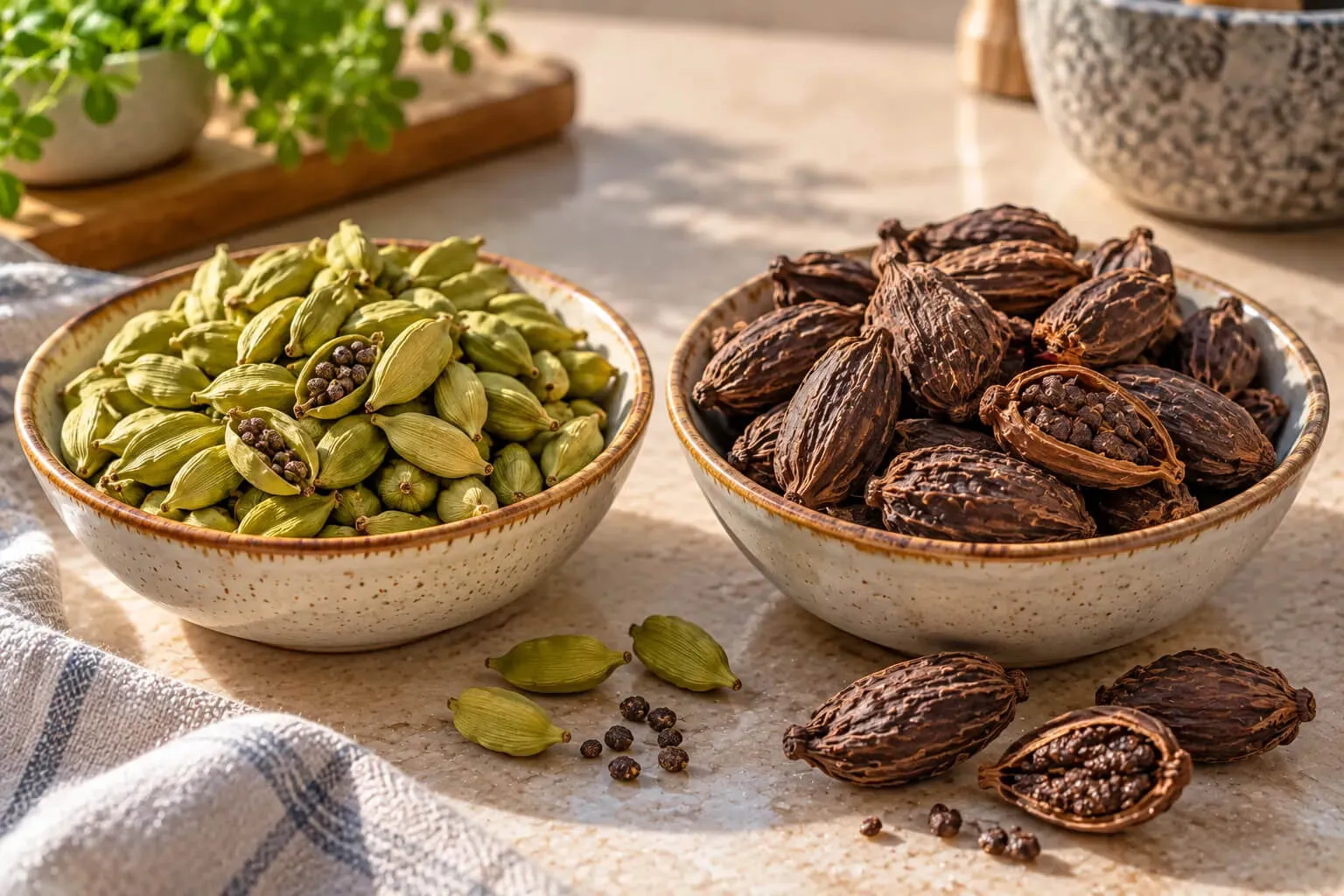
Green vs black cardamom looks like a simple colour choice, but the two spices bring noticeably different flavours to a dish. Green cardamom is usually bright, fragrant and slightly sweet, while black cardamom is larger, smokier and more assertive. If a recipe asks for one, swapping in the other without thinking can change the entire result.
In UK supermarkets, specialist spice shops and South Asian grocers, you may find green cardamom labelled elaichi, while black cardamom appears as badi elaichi or large cardamom. The common names can make them sound like different grades of the same spice. They actually usually come from different plant species, and their processing and culinary roles differ too.
This buyer’s guide explains what each type tastes like, where each works best, how to read the packet and what to do when your kitchen cupboard contains only one of them.
Green vs black cardamom: what’s the difference?
Green cardamom is commonly produced from Elettaria cardamomum. Kew’s plant records identify this as an accepted species in the ginger family, native to south-western India. Its small, pale green pods hold aromatic dark seeds. When lightly crushed, they release the scent familiar in chai, some rice dishes, baked goods and desserts.
Black cardamom used in South Asian cooking is commonly Amomum subulatum. Kew identifies it as a separate species. The pods are usually bigger, ridged and dark brown rather than smooth and green. Traditional drying methods can contribute a strong smoky aroma, which is useful in some savoury, slow-cooked dishes but intrusive in a delicate cake.
Both names can cover other botanicals in some markets, so exact identification matters if you are comparing a particular retailer’s products. For practical cooking, the most useful first check is whether a recipe calls for the small aromatic pods or the large smoky ones.
Green vs black cardamom at a glance
| Feature | Green cardamom | Black cardamom |
|---|---|---|
| Common botanical identity | Elettaria cardamomum | Amomum subulatum |
| Typical pod | Small, green, papery | Large, dark, deeply ridged |
| Typical aroma | Floral, bright, warm and sweetly aromatic | Smoky, earthy, deep and robust |
| Common recipes | Chai, desserts, baking, fragrant rice and curries | Rich curries, stews, lentils, stocks and biryani |
| Usual form | Whole pods, seeds or ground | Mostly whole pods or seeds |
| Direct substitution | Not a reliable one-for-one swap | |
This is a flavour guide rather than a universal rule. Cooking traditions and individual recipes vary. One cook may use green cardamom in a savoury curry, and another may use black cardamom in an aromatic rice dish.
7 essential green vs black cardamom differences
1. Their flavours do different jobs
The first difference is the one your guests will notice. Green cardamom can add a lift to warm, sweet or savoury flavours without making them taste smoky. Black cardamom brings a much heavier, fire-dried character. For a light custard or bun, a smoky note may feel unexpected. For a robust slow-cooked stew, it may work beautifully.
2. A pod is not a standard unit
One large black pod can be very different in size from one small green pod. Recipes that specify a number of pods are written with a particular ingredient in mind. Even two pods of the same kind vary in strength with freshness and storage. When learning a recipe, follow its named ingredient rather than adding the same number of the opposite type.
3. Green cardamom often works in sweet dishes
Green cardamom appears in tea, coffee, Scandinavian-style baking, rice pudding, biscuits and South Asian sweets. Its warm floral notes can sit alongside sugar, milk, nuts and fruit. For instance, a few gently crushed pods may flavour warmed milk and can be removed before serving.
Do not assume every whole pod is pleasant to bite. Where a recipe calls for infusing and removing the pod, take it out after cooking.
4. Black cardamom usually favours savoury cooking
Black cardamom often appears in biryani, hearty stews, lentil dishes and long-cooked sauces. Its deeper aroma can stand up to onion, garlic, ginger and other strong flavours. You will often add a whole pod early in the cooking process, letting its scent infuse the sauce and then removing the pod before serving.
Because the smoky profile can dominate, it is sensible to begin with the recipe’s suggested amount rather than adding more for ‘extra health benefits’. Culinary spices should not be treated as medicines.
5. Crushing pods changes how quickly flavour escapes
The seeds contain much of the aroma. Lightly crushing a pod before adding it to hot liquid exposes the seeds and can release flavour more quickly. Fine powder distributes widely, which may be useful for baking but harder to remove from a finished dish. The same general principle applies to both types, though their taste remains different.
If a recipe specifically asks for whole black cardamom, using ground green cardamom alters both the flavour and the handling of the spice. Choose a substitution based on what the finished dish needs, not simply on what is in your cupboard.
6. Ground spices lose their aroma faster
Whole pods generally protect the aromatic seeds better than a jar of powder that is opened repeatedly. Ground spice can still be convenient, particularly for measured baking. Buy a quantity you can reasonably use while it smells fresh. A much larger bag is not always better value if half becomes stale.
Keep your spices sealed in a cool, dry cupboard away from a sunny windowsill or the steam above your hob. The longer they are exposed to air, warmth and moisture, the less reliably they flavour food.
7. UK retail labels are not always precise
Packages may say ‘elaichi’, ‘large elaichi’, ‘brown cardamom’ or ‘black cardamom’. Some products may be sold as pods, seeds or powder. If botanical identity matters, look for the Latin name or contact the retailer. Also check net weight, ingredient additions, best-before date and responsible business details.
A product photograph is useful but not conclusive. It may show a loose pile of pods rather than the actual current packaging. Read the listing and packet together before buying.
Can you substitute green cardamom for black cardamom?
Sometimes a recipe will still be enjoyable with a different spice, but the result will not taste identical. Green cardamom cannot supply the characteristic smoky depth of black cardamom. Likewise, black cardamom can overwhelm a sweet mixture that expects green cardamom’s floral fragrance.
For an everyday curry, you could omit black cardamom rather than add a strong but mismatched spice without thinking. If you are making a carefully balanced dessert, green cardamom is worth seeking out. No single numerical substitution ratio works for every product or recipe.
What if the recipe only says ‘cardamom’?
Look at the context. Baking, chai and sweet puddings commonly imply green cardamom. Long-simmered South Asian meat dishes may include either type, often explicitly ‘black’ or ‘large’. Check a trusted version of the recipe or ask its author rather than assuming. The dish, cooking method and other spices provide more useful clues than the word ‘cardamom’ alone.
How to buy cardamom in the UK
- Check which pod the recipe uses. Do not assume colour is the only difference.
- Read the ingredient line. Choose plain spice unless you specifically want a mixture.
- Examine the form. Whole, seed-only and ground products behave differently.
- Compare price per 100g. The cheapest pack is not necessarily the most practical amount.
- Check the date and packaging. Airtight, dry storage helps preserve aroma.
- Read the allergen information. This matters especially for spice mixes or people with food allergies.
- Ask about missing details. A clear listing matters more than extravagant claims.
You can buy both forms from a good South Asian grocer, some supermarkets and specialist spice retailers in the UK. Stock and descriptions vary by shop, so verify the exact product rather than relying on a name in search results.
Green cardamom in Aura Blend’s ingredient list
Aura Blend’s ingredient overview names green cardamom among the ingredients in its herbal formula. That statement describes what the website lists; it does not establish the quantity of cardamom per serving or the finished product’s nutritional or clinical effects. If you need the current ingredients, serving quantities or allergen details, use the product enquiry contact before purchasing.
You may also like our guide to javitri and mace, another aromatic kitchen ingredient sometimes confused with other spices. Like cardamom, its culinary identity should not be used as proof of an unsupported medical benefit.
Green vs black cardamom: common questions
Is green cardamom the same as black cardamom?
No. They are normally sold as different spice species with distinct aromas. A labelled product’s botanical identity is more precise than its common name.
Which cardamom is used in tea?
Green cardamom is commonly used in chai and aromatic milk drinks. Black cardamom is smoky and is not the standard replacement for sweet tea recipes.
Can I use black cardamom in a cake?
It is possible to experiment with flavours, but its smoke-like note can dominate a cake designed for green cardamom. Follow a tested recipe if you want a predictable result.
Is ground cardamom the same as whole pods?
Ground spice distributes differently and loses aroma more quickly once exposed to air. You cannot reliably convert a whole-pod instruction to a teaspoon without knowing the recipe and product.
Which cardamom is healthier?
Neither should be marketed as universally healthier on the basis of colour. Culinary uses do not establish that a spice treats or prevents illness. Any health claim about a food or supplement needs appropriate evidence and must meet applicable UK rules.
How should I store cardamom pods?
Use a sealed container in a dry, cool cupboard, away from heat, sunlight and moisture. Check your own packet for specific storage instructions.
Final verdict: pick the flavour your recipe needs
The green vs black cardamom choice is about far more than pod colour. Green tends towards a fresh, floral warmth; black delivers a deeper, smokier note. The right pick depends on the recipe, cooking time and how the spice is used. For UK shoppers, checking the actual ingredient, form and pack information prevents the most common mistakes.
