

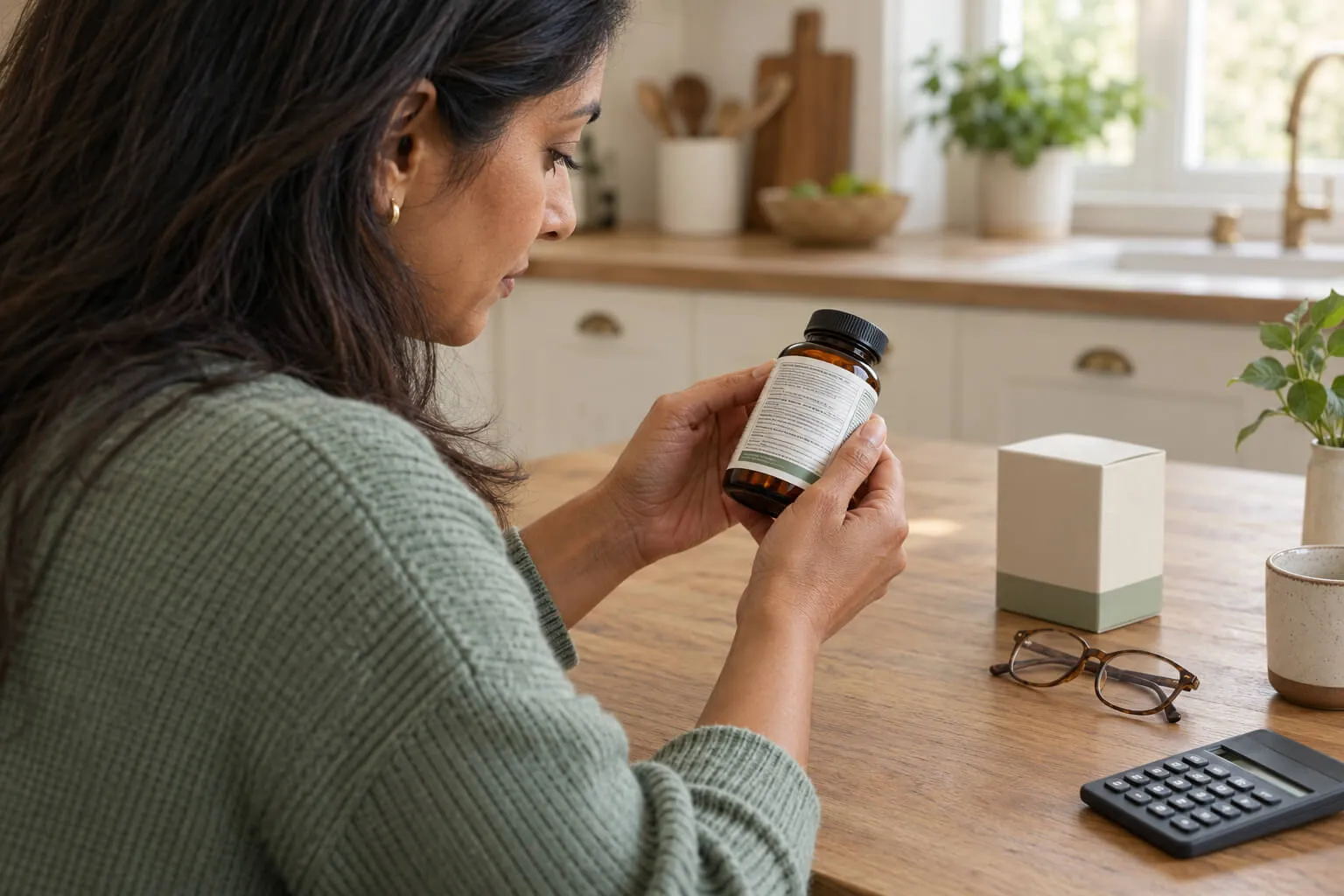
To learn how to read supplement labels in the UK, start with the recommended daily amount and then check what that amount contains. Read the full ingredients, warnings and storage instructions before comparing prices. The large number on the front of the pack is only useful when you know what it measures.
This is a practical guide to reading the packet in front of you. It does not decide whether you need a supplement or which dose is right for your health. For those decisions, a pharmacist or other appropriate healthcare professional can help.
1. How to read supplement labels: check the daily amount
A bottle may contain 60 capsules without providing 60 days of use. If the directions specify two capsules daily, it contains 30 daily portions. Similarly, the weight of a powder jar does not tell you how long it lasts unless the serving amount is clear.
Read the directions beside the ingredients table. Check whether the quantities are stated per capsule, per scoop, per serving or per recommended daily amount. A comparison becomes misleading when one product lists a single capsule and another lists two.
For powders, do not convert “one teaspoon” into a fixed number of grams yourself. The weight depends on the powder and how the spoon is filled. If the label uses a spoon measure but the comparison needs grams, ask the manufacturer for the corresponding amount.
2. Match the quantity, unit and ingredient
Read three things together: the ingredient name, its quantity and the unit. Milligrams and micrograms are different: 1 milligram equals 1,000 micrograms. A bigger-looking numeral is not necessarily a bigger amount.
Also check what the number describes. A whole blend, an individual ingredient and an ingredient equivalent are not interchangeable measurements. If a front label advertises a total blend weight, look for the breakdown rather than assigning that entire weight to its most prominent herb.
| What you see | What to check |
|---|---|
| “Per capsule” | How many capsules make the recommended daily amount? |
| “Per serving” | Is a serving one scoop, two capsules or another quantity? |
| A blend total | Are the individual ingredient quantities also given? |
| A percentage NRV | Which vitamin or mineral does it refer to, and for what portion? |
| An extract or equivalent figure | Does the label distinguish the extract quantity from the starting-plant equivalent? |
How to read supplement labels that show NRV percentages
NRV means Nutrient Reference Value. It is a labelling reference for vitamins and minerals, not a personalised prescription. Do not use the percentage as a score for the product: 200% is not a promise of twice the benefit, and 100% is not a statement that every person needs that amount from a supplement.
A herb may not have an NRV. That does not turn its amount into either a proven effective dose or a guaranteed safe dose. Those are separate questions requiring evidence about the actual ingredient and its use.
3. How to read supplement labels for ingredients and allergens
The named active ingredients are only part of the picture. Check the rest of the list for sweeteners, flavourings, coatings, capsule materials and other components relevant to you.
The Food Standards Agency’s supplement guidance describes label information including ingredients, emphasised allergens, daily directions, storage details, a date mark and responsible business details. Look for these on the actual packaging, not just a promotional image.
If you have an allergy, read the allergen statements and any precautionary warning each time you buy. The Food Standards Agency also cautions against treating a vegan label as a substitute for allergen information. “Vegan” alone does not establish that a product is suitable for someone with a milk or egg allergy.
If you cannot read the online label image, ask for a clear photograph. Do not try to fill the gaps from a similar product sold by another brand.
4. Separate useful information from marketing
Words such as “premium”, “advanced” and “traditional” do not provide the missing quantity, ingredient identity or preparation instructions. Treat them as a prompt to read further, not as a replacement for the back label.
The Food Standards Agency explains that food supplements are not intended to replace a varied diet or to be sold as treatments for medical conditions. Be cautious about a sales page that promises a cure while leaving basic product information unclear.
When a claim refers to research, check whether the research concerns the finished product or just one ingredient. A study title on a website does not establish that the packet contains the same preparation or amount used in that study.
What if a blend hides the individual amounts?
Make a list of what is known and what is missing. For example, a total of 1,000mg across several ingredients does not tell you that each ingredient contributes 1,000mg. If you need a specific amount for an informed decision, request the breakdown. Do not estimate proportions from the order of photographs on the website.
5. How to read supplement labels with a worked example
The following example demonstrates how to read supplement labels step by step. It is imaginary and is not a recommendation for an ingredient or daily dose.
- Container: 60 capsules.
- Directions: two capsules daily.
- Ingredient X: 400mg per two capsules.
- Price: £12, excluding delivery.
The container supplies 30 daily portions. The stated daily portion supplies 400mg of Ingredient X, not 800mg. The price is 40p per daily portion before delivery.
Now imagine another £12 bottle contains 60 capsules with directions for one capsule daily. It provides 60 daily portions at 20p each. That arithmetic does not establish equivalence: you still need to compare ingredients, forms and quantities. Price per capsule alone would miss the difference in directions.
6. Check warnings, dates and the business behind the packet
Knowing how to read supplement labels includes checking age restrictions and any warnings relevant to your circumstances. The Food Standards Agency advises people who are pregnant, breastfeeding, taking regular prescribed medicines or living with medical conditions to seek professional advice before taking a food supplement. Follow the recommended amount rather than increasing it to chase faster results.
Record the batch or lot number if supplied, keep your order confirmation and follow the storage instructions. If the seal is damaged or the online description and received label disagree, contact the seller before use.
How to read supplement labels: 8 mistakes to avoid
These eight checks help you avoid common label-reading mistakes, including missing a daily amount, overlooking allergens or comparing unmatched portions.
- I know what the product is and what is in it.
- I can identify the recommended daily amount.
- I understand which portion the quantity table describes.
- I have checked the units and any missing ingredient amounts.
- I have read the full ingredients and allergen information.
- I have reviewed the warnings and sought advice where appropriate.
- I can identify the responsible business and contact it.
- I have checked the date, storage directions and delivered price.
If you are comparing Aura Blend’s herbal vitality formula, use the same checks. A list of ingredients does not by itself establish the amount of each ingredient in a serving. Request unclear details through Aura Blend’s product enquiry contact before making a decision.
Common questions
Does a higher milligram amount mean a better product?
No. First check that the quantities refer to the same ingredient, preparation and portion. Even then, a quantity comparison does not establish which product you need or which is appropriate for you.
Can I use the seller’s description instead of the packet?
Use the description to research your purchase, then check the current packaging when it arrives. Ask the seller to resolve any discrepancy rather than assuming a website image reflects every batch.
Is a clear label proof that a supplement works?
No. A clear label helps you understand the product. Evidence of benefit, personal suitability and product quality require their own checks.
Make missing information part of the decision
Knowing how to read supplement labels helps you answer straightforward questions without guessing. Read the daily amount and quantities together, check the complete ingredients, and keep a note of anything unclear. If the seller cannot answer a question that matters to your decision, pause the purchase rather than relying on a confident headline.

1 Comment
Is Mishri Healthier Than Sugar? 7 Myths to Avoid - Aura Blend
October 26, 2026[…] a closer look at ingredient panels, serving sizes and warnings, read our practical UK supplement-label checklist. A product claim should not take the place of a readable […]