

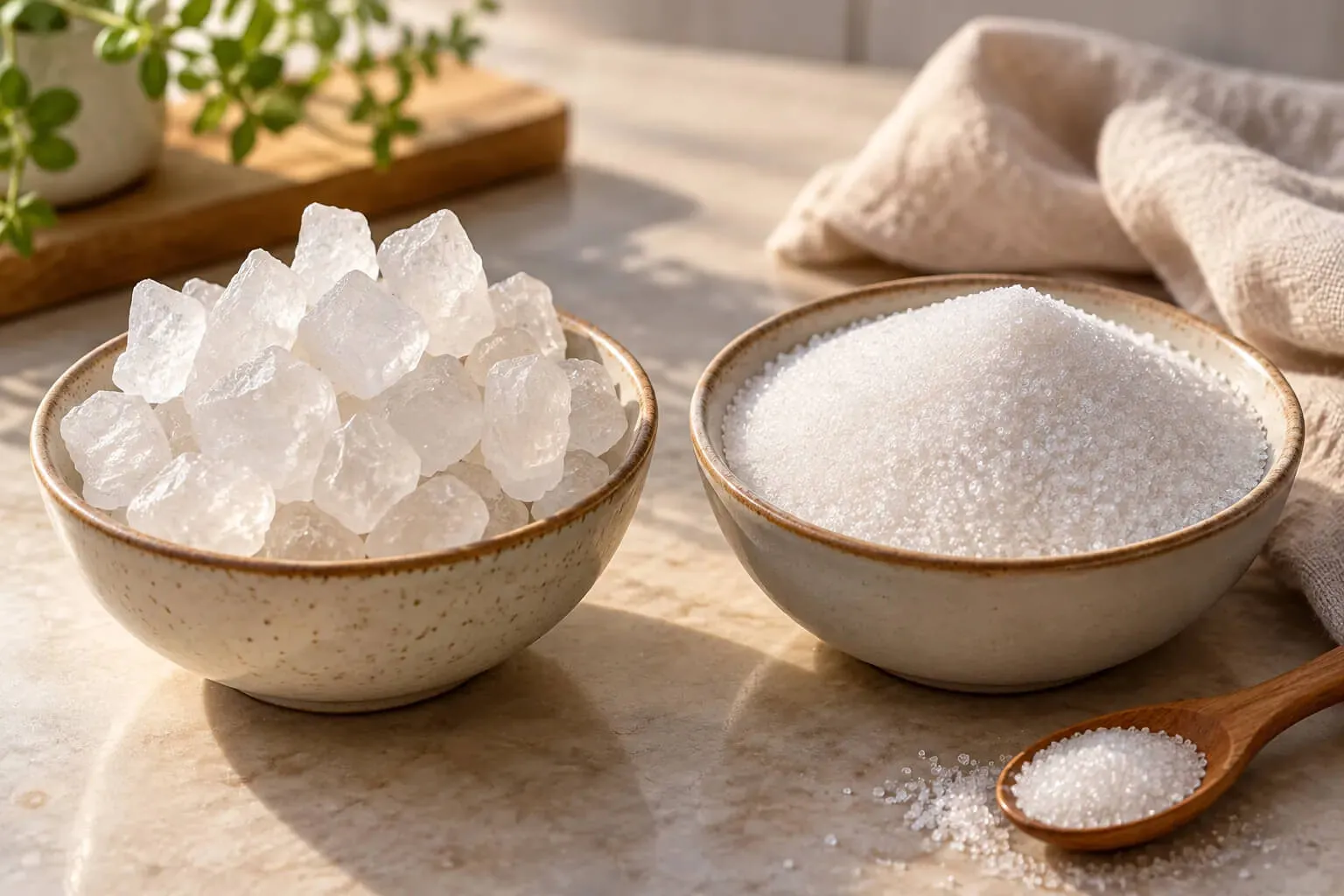
Is mishri healthier than sugar? For ordinary white rock sugar sold as mishri, the short answer is no: larger crystals do not turn sugar into a healthier sweetener. Mishri is commonly a crystallised form of sugar, and its effect depends mainly on what is in the product and how much you use, not on whether the crystals look traditional or less processed.
In UK shops you may see it labelled mishri, misri, rock sugar, sugar candy or crystallised sugar. Some families use it in tea, warm milk or South Asian recipes. Those uses are real, but claims that it is automatically better for blood glucose, teeth or weight need much more than the name on a packet.
This practical guide compares mishri with granulated white sugar, explains what UK sugar guidance actually says, and shows how to read a label before buying.
Is mishri healthier than sugar? The quick answer
When two products are essentially crystallised sucrose, there is no good reason to treat one as a sugar-free or low-sugar alternative just because one has large, irregular crystals. Both add sugar to food or drink. Even if a particular packet is advertised as traditional or minimally processed, it does not follow that it has a meaningful health advantage.
A brand can offer different origins and manufacturing methods. Before making a comparison, read the actual ingredient declaration. If it lists sugar, that tells you far more than a front-of-pack phrase such as “natural sweetness”.
It is also important to compare equal weights. One lump and one teaspoon are not standard units of sugar: their weights can differ, which makes casual comparisons misleading.
What is mishri, and how is it made?
Mishri usually refers to pieces of rock sugar formed as sugar crystallises. They can be translucent, pale white or slightly coloured. Depending on the manufacturer, you may find thread mishri, chunky pieces, crushed crystals or other traditional styles. The appearance differs from the fine grains sold as regular table sugar.
In a typical production process, dissolved sugar forms larger crystals under controlled conditions. A rock-sugar manufacturer may start with refined sugar. The fact that the end product looks different does not mean its sugar has vanished or changed into a special nutrient.
Does “unrefined mishri” mean it is good for you?
Not by itself. “Unrefined” is a description that deserves checking, not a health result. Different retailers can use the word loosely. Ask what the sweetener is made from and look for reliable composition and nutrition information rather than assuming it is rich in useful minerals.
If a specific product genuinely differs from ordinary rock sugar, the seller should explain the ingredient and composition clearly. Without that information, a health comparison is speculation.
7 mishri myths to avoid when choosing a sweetener
Myth 1: Big crystals mean less sugar
Size and shape change how you measure the product, not what a gram of it is. A large mishri piece may weigh more than it looks. Breaking up a lump does not reduce the quantity of sugar you eat.
Myth 2: Mishri is naturally safe for unlimited use
Neither “traditional” nor “natural” means unlimited. The NHS identifies sugars added to foods and drinks as free sugars, which are the type people in the UK are advised to limit. Added rock sugar belongs in that discussion.
Myth 3: Rock sugar cannot affect blood glucose
If mishri contains digestible sugar, it contributes carbohydrate that matters to blood glucose. Diabetes UK explains that the amount of carbohydrate in a portion can matter more than relying on a single glycaemic index figure. Someone managing diabetes should count mishri as sugar, not as an exempt alternative.
Myth 4: It is a proven remedy because it is used in home recipes
Traditional use and scientific proof are different. Mishri appears in familiar food and drink preparations, but that does not establish that it treats coughs, improves hormones, cures tiredness or works better than standard care. Be especially cautious of health promises linked to a product without evidence about that exact preparation.
Myth 5: Mishri contains enough minerals to replace healthy foods
A product might contain traces of other components, but a trace is not a useful dietary amount. The nutritional case for eating fruit, vegetables, pulses and other varied foods cannot be replaced by claims about crystals of sugar. Check an actual nutrition label before believing a seller’s mineral claim.
Myth 6: Switching sugar types is the same as reducing sugar
If you remove a spoonful of granulated sugar and replace it with an equal weight of rock sugar, you have changed the form but not necessarily reduced free sugar intake. The more useful question is how much sweetener ends up in your drink or recipe.
Myth 7: A traditional name guarantees quality
Mishri, misri, rock candy and rock sugar are names used across different markets. Names alone cannot confirm the ingredients, allergens, suitability, storage directions or business responsible for a product. A clear label and traceable seller matter more than romantic packaging.
So, is mishri healthier than sugar after these seven checks? For ordinary sugar crystals, there is no established advantage that justifies using more of them. Choose the taste and texture you like, but keep the quantity in view.
What UK advice says about free sugars
The NHS explains that free sugars include sugars added to food or drinks as well as sugars naturally found in honey, syrups and juice. Its guidance says free sugars should account for no more than 5% of daily energy intake. For adults, NHS guidance translates this into no more than about 30g of free sugars a day.
That recommendation applies across food and drink, not separately to every source of sweetness. Adding mishri to tea, sugar to coffee and syrup to a dessert can all contribute to the same overall intake.
What about “of which sugars” on the packet?
UK nutrition labels commonly show carbohydrates and an “of which sugars” amount. This measures total sugar and does not distinguish every type of free sugar. The ingredients list helps you understand whether sugar has been added.
For packaged foods, the NHS describes more than 22.5g of total sugars per 100g as high and 5g or less per 100g as low. Plain sugar is plainly not a low-sugar food, regardless of crystal size. These thresholds are for comparing packaged foods, not a claim that 22.5g is a recommended serving.
For a closer look at ingredient panels, serving sizes and warnings, read our practical UK supplement-label checklist. A product claim should not take the place of a readable label.
Mishri vs regular sugar: what actually changes?
| Question | Mishri or rock sugar | Regular white sugar |
|---|---|---|
| Appearance | Large crystals or irregular lumps | Smaller granules |
| Typical identity | Crystallised sugar; check the packet for specifics | Granulated sucrose |
| Sugar contribution | Counts as added sugar when used to sweeten food or drinks | Counts as added sugar when used to sweeten food or drinks |
| Ease of measurement | Pieces differ in size; weigh when precise amounts matter | Granules are easier to portion consistently, but weighing is most precise |
| Best reason to choose | Texture, slow dissolution, flavour preference or a traditional recipe | Convenience, cost and suitability for a recipe |
| Proven health superiority | Not established for ordinary crystallised sugar | Not a health food either |
A simple portion calculation
As a worked example, suppose you add 5g of either pure sugar to tea. Sugar provides around four kilocalories per gram, so that amount contributes roughly 20 kilocalories. The calculation illustrates why weighing the amount is more informative than counting pieces or spoonfuls. It does not tell you whether one brand’s crystals weigh 5g.
Ask yourself is mishri healthier than sugar because of an ingredient difference, or simply because of a different-looking portion? If the ingredient is essentially the same, portion size is the more useful place to focus.
Is mishri a better choice for people with diabetes?
Do not treat mishri as sugar-free. For someone with diabetes, carbohydrate amount, the rest of the meal, medicines and individual circumstances all affect the picture. Diabetes UK advises considering carbohydrate portions and overall eating patterns rather than relying on a glycaemic index claim alone.
Claims that a particular mishri has a “low GI” should be supported by reliable testing of that product. We have not found a reason to apply a special low-GI figure to every packet labelled mishri. If you need personalised guidance, ask a qualified diabetes clinician or registered dietitian.
In this context, is mishri healthier than sugar is not the right shortcut to make a treatment decision. A health professional can help you make a plan based on your actual meals and blood glucose needs.
Does mishri help with coughs, digestion or energy?
Some traditional recipes pair mishri with herbs, spices or warm drinks. A warm drink may feel soothing, and a sugary ingredient may make a recipe more pleasant, but those experiences do not demonstrate a medical benefit of mishri itself.
Claims that it treats a disease, changes testosterone, “balances hormones” or delivers a special energy boost are not established simply by cultural use. Remember that sugar provides dietary energy; that is not proof that one type improves stamina or recovery more than another.
For readers investigating blended products, Aura Blend’s ingredient overview includes rock sugar or mishri among several ingredients. That listing does not establish the quantity per serving or prove a health effect of the finished blend. If the breakdown matters, ask the seller for the current product information.
How to buy mishri in the UK without guessing
When shopping online or in a South Asian grocery, these steps will help you choose the right product without mistaking presentation for nutrition:
- Read the ingredient list. Check whether it names sugar, sugarcane, another source or added flavours.
- Check the form. Large pieces, thread crystals and crushed mishri may behave differently in a recipe.
- Look for a clear label. Verify quantity, responsible business, date and storage instructions.
- Compare price per 100g. A small decorative packet may cost much more than a plain bag of sugar.
- Weigh your portion. A single lump is not a standard measure.
- Avoid medical shortcuts. Health claims should be backed by evidence about the actual product.
- Check suitability. If you have a relevant medical condition, are on medication or have an allergy concern, do not infer suitability from a traditional name.
If a retailer provides only a dramatic front-label claim, ask for the back label. You can also use Aura Blend’s contact page to request information about ingredients used in its own blend.
When might you still prefer mishri?
There are perfectly good culinary reasons to choose it. Large crystals can dissolve differently from fine sugar and may suit a specific traditional dish. A family recipe may use mishri for its appearance, texture or familiar taste. These are preferences, not health claims.
The practical answer to is mishri healthier than sugar does not mean you must never eat mishri. It means the decision should be about the recipe and the amount used, rather than expecting a metabolic benefit that the evidence does not establish.
Frequently asked questions
Is mishri healthier than sugar for everyday tea?
For ordinary crystallised sugar, there is no established health advantage. If you enjoy mishri in tea, measure how much you use and count it as added sugar rather than a free replacement.
Is mishri the same as sugar candy?
Many retailers use mishri, rock sugar and sugar candy for large crystals of sugar. However, product names are not a substitute for an ingredients list, especially when colours or flavours differ.
Can mishri replace white sugar in recipes?
Often it can provide sweetness, but different crystal sizes affect dissolution. For reliable baking or nutrition calculations, compare by weight and follow the recipe’s method rather than replacing “one spoon” with “one lump”.
Is mishri sugar-free or suitable for a low-sugar diet?
No. Ordinary mishri is a sugar product. A low-sugar eating pattern is better served by considering how much sugar you add across the day, not by assuming a different name removes the sugar.
Is brown or yellow mishri more nutritious?
Colour alone does not verify meaningful mineral content or health benefit. Look for accurate product composition data and be sceptical of sweeping claims.
Can I trust a claim that mishri has a lower glycaemic index?
Not without relevant evidence for that particular product. Glycaemic index does not replace the need to check carbohydrate portion size, especially for people managing diabetes.
Final verdict: choose the amount, not the myth
Is mishri healthier than sugar? If the mishri you are comparing is ordinary crystallised sugar, there is no established reason to regard it as a healthier substitute for an equal weight of table sugar. The crystal shape may change how you use it in the kitchen, but it does not remove the sugar.
For a useful UK buying decision, check the ingredients, measure the portion and treat broad health claims cautiously. If you want to cut down on free sugars, reducing the amount you use is more meaningful than simply swapping granules for crystals.
