

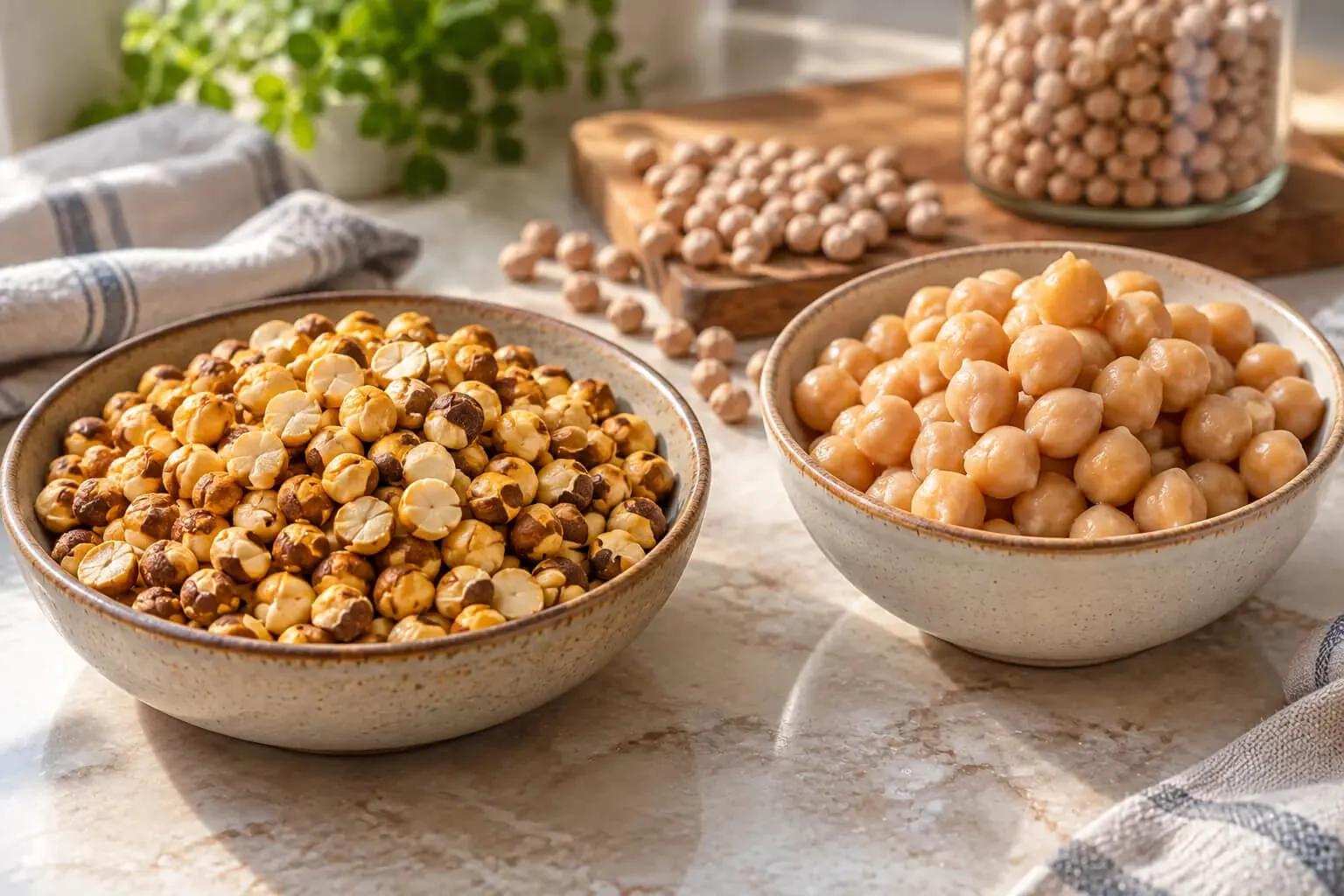
Roasted chana vs chickpeas: what is the real difference?
Chickpea is the broad English name of the pulse. Chana is used for chickpeas in South Asian languages and on many British Asian grocery labels. Roasted chana usually refers to chickpeas or Bengal gram prepared by roasting to make a dry, crunchy product. Depending on the brand, the grain may be whole, skinned or split.
That is quite different from a tin of chickpeas. Tinned chickpeas have been cooked and packed in liquid; they are soft and work well in hummus, curries or salads. A bag of dried raw chickpeas needs preparation and cooking before it can be eaten. A packet specifically sold as ready-to-eat roasted gram has already undergone a different preparation process.
There is also a distinction between the small, darker desi-type chickpea often called Bengal gram and the larger, pale kabuli chickpea familiar from many tins. Both belong to Cicer arietinum, but variety and processing affect their appearance and how they work in recipes. The Academy of Nutrition and Dietetics describes Bengal gram and chana dal as forms associated with the desi chickpea.
For most shoppers, the sensible first question is not which word is correct. It is: What form is in this packet, and is it intended to be cooked or eaten as supplied?
Understanding the different names on UK shelves
Food names move between languages, regions and generations. That is why a roasted chana vs chickpeas search can lead to products that look and cook very differently. The same word does not always mean the same finished product in every shop.
- Chickpeas / garbanzo beans: broad names for the pulse, commonly sold dried or tinned.
- Kala chana / black chana: usually smaller, darker, whole desi chickpeas. The colour refers to the darker seed coat, not an entirely different species.
- Chana dal: split, generally hulled desi chickpeas used in cooked dishes. A packet of uncooked chana dal is not the same as a ready-to-eat roasted snack.
- Bhuna chana / roasted gram: roasted chana, often sold as a crunchy snack, whole or in other processed forms. Check the exact packet.
- Roasted split gram / pottukadalai / dalia: a prepared split roasted gram often used in chutneys and snacks; do not assume a packet labelled simply “dalia” always identifies the same ingredient.
- Roasted chickpea snack: in UK snack aisles this can also mean cooked kabuli chickpeas seasoned and oven-roasted with oil.
If you need a particular item for a recipe, a picture and a common name may not be enough. Check the ingredient declaration, the shape of the grains, and any preparation instructions.
Roasted chana vs chickpeas: 7 easy ways to choose
1. Check whether the product is ready to eat
For roasted chana vs chickpeas, the first practical distinction is whether the product is ready to eat. A bag of crunchy, ready-to-eat roasted chana is meant to be eaten as sold when the label says so. Dry raw chickpeas, however, should not be treated as an instant snack. The Food Standards Agency advises following pack instructions for soaking and cooking dried pulses because correct preparation matters for food safety. Tinned chickpeas are already cooked.
Do not rely only on appearance. When the pack does not tell you whether the gram is pre-cooked or roasted sufficiently for direct consumption, contact the retailer before eating it.
2. Look at whole, split and hulled forms
A roasted chana vs chickpeas photograph cannot tell you whether the husk is still attached. Whole roasted chana can have a seed coat and a firm bite. Split roasted gram looks different and is often easier to grind for chutneys. Whole tinned chickpeas are soft and moist, while raw chana dal is split but still needs cooking. Removing the husk can also change the fibre information, so it is unwise to assume the same nutrition for every form.
3. Compare dry and cooked weights fairly
Moisture is easy to overlook in roasted chana vs chickpeas nutrition comparisons. It changes nutrition figures per 100g. A dry roasted product has relatively little water, whereas drained tinned chickpeas contain more. If the dry snack appears to contain more protein per 100g, part of that contrast can be due to the water content, not a fundamentally different ingredient.
Compare the portion you would actually eat and the label for the exact product. A 30g handful of roasted gram should not be treated as equivalent to 100g of cooked chickpeas merely because both are made from chickpeas.
4. Read the salt and oil ingredients
In roasted chana vs chickpeas shopping decisions, seasoning can matter more than the name. Plain roasted gram may contain only chickpeas, but not every roasted chickpea snack is plain. Some products contain added oil, salt, sugar, spice mixes or coatings. The British Heart Foundation notes that pulse-based snacks can be higher in salt or fat despite being made from pulses.
NHS food label guidance classifies foods with more than 1.5g of salt per 100g as high in salt, while 0.3g or less is low. These values help compare snack packs in the UK. Read both the ingredients and the nutrition table rather than assuming “roasted” means no added fat.
5. Match the texture to your recipe
For roasted chana vs chickpeas in recipes, start with texture. A salad needs a different texture from a crunchy trail snack. For hummus or a soft curry, cooked chickpeas are usually the useful starting point. For a ready-to-eat crunchy snack, a labelled roasted chana product may be convenient. Some chutneys use roasted split gram for body, but you cannot automatically replace it with raw chana dal or whole tinned chickpeas and expect the same result.
The preparation method is part of the recipe. Check whether it asks for “roasted gram”, “chana dal”, “boiled chana” or “chickpeas”, and follow that specific form.
6. Ask what the word “healthy” means on the label
Chickpeas contribute protein and fibre as part of a varied diet, but that does not mean every flavoured chickpea snack has an identical nutritional profile. A product can be based on pulses and still have a relatively high salt content. Likewise, higher protein per 100g is not enough to judge whether a food is right for a particular person.
The NHS advises including pulses such as chickpeas in meals. That is general dietary guidance, not proof that a branded roasted-chana blend has special effects on stamina, hormones or recovery.
7. Compare the total cost of the portion you need
Roasted chana vs chickpeas prices are difficult to compare without considering moisture and pack size. A £2 snack pouch might look less expensive than a large bag, but compare cost per 100g and then consider the amount you will actually use. With dried chickpeas, remember that cooking increases their weight by adding water. With canned chickpeas, compare the drained weight where available. With roasted snacks, check the edible net weight and any delivery charges.
A useful comparison accounts for convenience too. A ready-to-eat packet costs more for a reason if you would otherwise need time and equipment to prepare an ingredient.
Roasted chana vs chickpeas: UK buyer’s comparison table
| Product | Typical texture and form | Preparation | Practical use |
|---|---|---|---|
| Ready-to-eat roasted chana | Dry, crunchy, sometimes whole or split | Usually ready as labelled; check pack | Snack or selected traditional recipes |
| Raw dried chickpeas | Hard, dry, whole grains | Soak and cook as directed | Curries, soups, salads after cooking |
| Tinned chickpeas | Soft, moist and cooked | Drain or rinse as needed; ready to use | Hummus, curries, salads |
| Raw chana dal | Dry, split and usually skinned | Cook as directed | Dal and other cooked dishes |
| Roasted split gram | Dry, usually pale and split | Often ready to use as sold; check pack | Chutneys, snacks and recipe mixes |
| Seasoned roasted chickpeas | Crunchy, often coated | Ready-to-eat snack as labelled | Convenient savoury snack |
The word “roasted” is not a universal guarantee that the product contains no oil, and “chana” is not enough to establish whether a grain is raw or ready to eat.

Are roasted chana and chickpeas equally nutritious?
Both can be useful ways of eating pulses. The roasted chana vs chickpeas choice depends on which product you actually eat. The British Heart Foundation describes pulses as sources of protein and fibre, and the NHS recommends adding them to everyday dishes. Yet the exact nutrition depends on variety, preparation, water content, hull removal and additional ingredients.
A fair roasted chana vs chickpeas nutrition check uses the information on the exact product, not a generic figure taken from a different type of chickpea. A simple table can make comparisons clearer:
- Protein per portion: compare the amount you would realistically eat, not just a per-100g headline.
- Fibre: check whether the product is hulled and read the declared fibre content.
- Salt: especially important when choosing flavoured or seasoned snacks.
- Fat: roasted snacks can contain added oils, while plain cooked pulses may not.
- Calories: water makes cooked pulses less energy-dense per 100g than many dry snacks.
What does an 80g portion mean in the UK?
The NHS says an 80g serving of beans or pulses such as chickpeas counts towards your 5 A Day, but beans and pulses can count only once per day in that scheme. This advice should not be misread as an instruction to eat 80g of dry roasted gram. The serving guidance concerns beans and pulses as described in the NHS scheme, and dry snack packets have different water content and serving suggestions.
If a packet makes a specific nutrition claim, compare it with the stated serving size. A label that gives only per-100g figures still needs some simple portion arithmetic before it answers what is in your snack.
A hypothetical label comparison
Imagine roasted snack A has 1.8g salt per 100g. A 25g portion would contain 0.45g salt. That is a mathematical illustration, not a verified figure for roasted chana sold by Aura Blend or any other brand. Now imagine plain snack B has 0.2g salt per 100g; an equally weighed 25g portion would contain 0.05g salt. Check the actual packages before using these figures to make a purchase.
Our guide to reading labels in the UK explains how to match a serving size to a nutrition panel. While written for supplement labels, its portion-reading principles can help you spot misleading comparisons elsewhere.
Which chickpeas should you buy for different recipes?
For a crunchy desk or travel snack
Choose a clearly labelled ready-to-eat roasted gram product. Check whether you prefer the firmer whole version or a split form, and consider the salt content. Keep it dry after opening according to the packaging instructions. Hard pieces can present a choking risk for young children, so offer age-appropriate foods instead.
For curries and chana masala
Use properly cooked chickpeas or dried chickpeas that you prepare according to the pack. Canned chickpeas are convenient when time is short. A crispy, dry roasted snack is not a straightforward replacement when the dish relies on soft chickpeas absorbing a sauce.
For hummus and creamy spreads
Soft cooked or drained tinned chickpeas are generally a better starting point. The creaminess comes from a very different texture from crunchy roasted gram. Blending a dry snack without suitable preparation will not give the same result.
For chutneys or South Asian mixes
Roasted chana vs chickpeas substitutions need extra care in chutneys. Some recipes specifically call for roasted split gram, often called pottukadalai. The word “roasted” in this context may refer to a different prepared ingredient from a packet of spiced whole roasted chickpeas. Check the packet description before swapping them.
For ingredient-blend research
Aura Blend lists roasted chickpeas among its formula ingredients. That verifies only what the brand says is in its product. It does not establish the ingredient quantity, finished blend’s protein content, or a specific health benefit. If you need a precise serving breakdown, ask for the current label using Aura Blend’s contact page.
How to check a UK packet before buying
Before making a roasted chana vs chickpeas purchase, run through this straightforward checklist:
- Find the exact ingredient name and whether the chickpea is whole, split or skinned.
- Identify whether the contents are raw, cooked, canned or ready-to-eat roasted.
- Check preparation and storage instructions, including directions after opening.
- Compare salt and fat per 100g if it is a seasoned snack.
- Read the allergen statement and any cross-contact warning relevant to you.
- Compare the portion you intend to eat and the price per useful amount.
- Confirm that your recipe calls for the same texture and preparation.
UK food labelling rules require relevant ingredients and allergen information on packaged foods. If an online listing is unclear, request a photograph of the current label rather than relying on a marketing picture.
Frequently asked questions
Are roasted chana and chickpeas the same plant?
Many products marketed as chana and chickpeas come from Cicer arietinum. However, roasted chana describes a prepared form, and products can use different chickpea varieties or processing methods. Check the label for the exact item.
Is roasted chana the same as canned chickpeas?
No. A ready-to-eat roasted gram product is dry and crunchy; canned chickpeas are cooked and moist. Their preparation, texture and nutrition per 100g can differ because of water and any added ingredients.
Do dried chickpeas have to be cooked?
Yes. Treat raw dried chickpeas as an ingredient that needs proper preparation. Follow the pack’s soaking and cooking directions. Do not assume they are ready to eat because roasted chana is sold as a snack.
Is roasted chana better than crisps?
Some plain roasted pulse snacks offer fibre and protein, but branded snacks vary widely. The British Heart Foundation advises checking fat and salt even with pulse-based snacks. Compare two actual labels rather than giving the whole category a health halo.
Are gram flour, chana dal and roasted chana interchangeable?
Not automatically. Gram flour, raw split dal and roasted prepared gram have different textures and cooking requirements. Use the form specified in the recipe, particularly where raw ingredients need cooking.
Can roasted chana be a protein source?
Chickpeas contain plant protein, but the amount in a serving of roasted chana depends on the particular product and portion. Read the label instead of relying on a general claim for all roasted gram snacks.
Can I replace cooked chickpeas with roasted chana in hummus?
That would change the texture considerably. Use cooked chickpeas for a traditional creamy hummus recipe, unless the recipe explicitly explains how to prepare a roasted form.
Final verdict: buy the form, not just the name
The answer to roasted chana vs chickpeas is not that one is always healthier or better. The names are related, but what you receive might be a ready-to-eat roasted snack, uncooked dry gram, cooked chickpeas, or a split ingredient meant for a particular recipe.
For everyday UK shopping, check the form, cooking instructions, salt and oil, and your intended portion. Those details will make a bigger difference to your meal or snack than a broad name on the front of the packet.
